
To make DJMAX RESPECT mode work, special converter is necessary
To use DJMAX RESPECT mode, the latest firmware is necessary
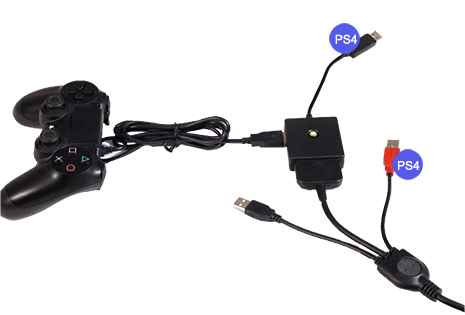
After you connect the controller according to the following steps, you can make DJMAX RESPECT mode work normally.
Converter doesn’t support PS4 PRO game body for the time being.
The blue pilot light of the converter should turn green, and keep shining after flashing about 30 seconds, then you can play game libmediaprovider
Press start+select+5, simultaneously about a second, PS2 IIDX mode and DJMAX RESPECT mode of the controller can be switched repeatedly
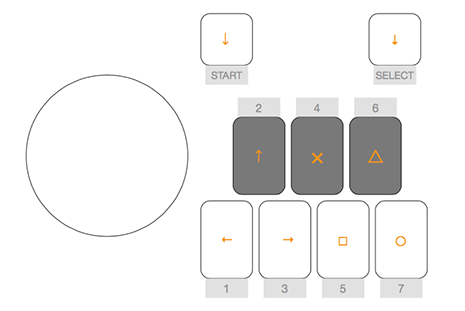
Key mapping is shown as following image
| Controller | PS4 key |
| Start | left stick ↓ |
| Select | right stick ↓ |
| 1 | ← |
| 2 | ↑ |
| 3 | → |
| 4 | × |
| 5 | □ |
| 6 | △ |
| 7 | ○ |
| Rotate turntable clockwise | left stick ↓ |
| Rotate turntable counterclockwise | left stick ↑ |
| Controller | PS4 key |
| Start+Select+4 | Option |
| Start+1 | L1 |
| Start+2 | R1 |
| Start+6 | R2 |
| Start+7 | L2 |
| Start+Select+5 | Switch for PS2 IIDX/DJMAX RESPECT game mode |
The details of the other questions are shown in “Common Question” in the bottom of this page
Introduction When you open a music player and see all your songs appear within milliseconds, or when a gallery app shows every photo organized by date, you are witnessing the end result of a complex data management process. At the heart of this process lies a shared library known as LibMediaProvider .
#00 pc 0x5a2c4 /system/lib64/libmediaprovider.so (ExifParser::parseThumbnailOffset+172) #01 pc 0x5b8e0 /system/lib64/libmediaprovider.so (MediaScanner::processImageFile+324) LibMediaProvider emits native systrace events:
On a typical Android device, you can find it at:
For most Android developers, the MediaStore API is the familiar interface for querying media files. However, behind that API, deep within the system server’s process, sits libmediaprovider.so —a native shared library that powers the MediaProvider service. This article dissects the architecture, functionality, and internal workings of LibMediaProvider, offering a rare look into one of Android’s most performance-critical native components. LibMediaProvider is a native shared library ( .so file) that implements the core logic for Android’s MediaProvider —a system service responsible for indexing, storing, and retrieving metadata about media files (audio, video, images, and downloads). While the MediaProvider itself is written in Java/Kotlin as an androidx.content.ContentProvider , its heavy lifting—especially around file I/O, metadata extraction, and database optimization—is delegated to native code via LibMediaProvider.