Attribution Creative Commons Noncommercial No Derivatives Share Alike Zero

Laura Tithapia //free\\ (2026 Update)

In an era of loud branding and relentless self-promotion, is a disarming anomaly. She doesn't seek the spotlight, yet the spotlight seems magnetically drawn to her.

That friction forged what colleagues have dubbed the Tithapia Tenacity : the ability to absorb a setback, analyze its architecture, and return with a solution that addresses the root cause, not just the symptom. Tithapia first entered the public eye not through a viral moment, but through a white paper. While studying at the [Prestigious University—e.g., London School of Economics / MIT], she published a dense, 80-page treatise titled The Agora Protocol: Decentralized Problem-Solving in High-Stakes Environments . laura tithapia

It was initially dismissed by traditionalists as "radical." Then, three separate humanitarian crises later, her model was adopted by two international aid organizations. Today, the "Tithapia Model" is standard curriculum at several war colleges and disaster management institutes. On her desk sits a single bonsai tree. It is her only decoration. She points to it when asked for her leadership philosophy. In an era of loud branding and relentless

"It teaches you that identity is not a zip code or a bank account," she told me over tea at a quiet cafe in [Capital City]. "Identity is your response to friction." Tithapia first entered the public eye not through

The daughter of a civil engineer and a librarian, she learned to build things that last (from her father) and to tell stories that matter (from her mother). At 14, a sudden economic collapse in her home country forced her family to relocate and start from zero. While most teenagers would fracture under the pressure, Tithapia saw it as a laboratory.

Given the ambiguity of the name (it does not correspond to a widely known real person as of 2026), this feature is built in a style. You can adapt the details (age, specific profession, location) as needed. Laura Tithapia: The Quiet Force Rewriting the Rules of Resilience By [Your Name/Staff Writer]
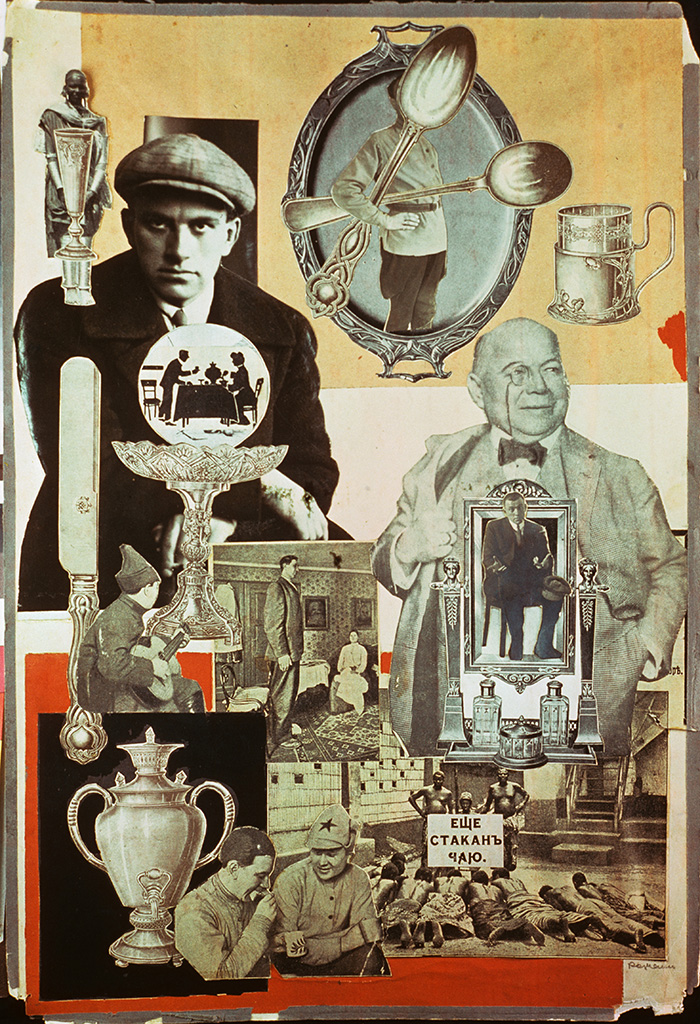
Fig. 1. — Brigade KGK (Viktor Koretsky [1909–98], Vera Gitsevich [1897–1976], and Boris Knoblok [1903–84]). “We had to overcome among the people in charge of trade the unhealthy habit of distributing goods mechanically; we had to put a stop to their indifference to the demand for a greater range of goods and to the requirements of the consumers.” From the 16th to the 17th Congress of the All-Union Communist Party (Bolsheviks), 1934, no. 57, gelatin silver print, 22.7 × 17 cm. Los Angeles, Getty Research Institute, 2014.R.25.
Fig. 2. — Brigade KGK (Viktor Koretsky [1909–98], Vera Gitsevich [1897–1976], and Boris Knoblok [1903–84]). “There is still among a section of Communists a supercilious, disdainful attitude toward trade in general, and toward Soviet trade in particular. These Communists, so-called, look upon Soviet trade as a matter of secondary importance, not worth bothering about.” From the 16th to the 17th Congress of the All-Union Communist Party (Bolsheviks), 1934, no. 56, gelatin silver print, 22.7 × 17 cm. Los Angeles, Getty Research Institute, 2014.R.25.
Collage of photographs showing Vladimir Mayakovsky surrounded by a silver samovar, cutlery, and trays; two soldiers enjoying tea; a giant man in a bourgeois parlor; and nine African men lying prostrate before three others who hold a sign that reads, in Cyrillic letters, “Another cup of tea.”
Fig. 3. — Aleksandr Rodchenko (Russian, 1890–1956). Draft illustration for Vladimir Mayakovsky’s poem “Pro eto,” accompanied by the lines “And the century stands / Unwhipped / the mare of byt won’t budge,” 1923, cut-and-pasted printed papers and gelatin silver photographs, 42.5 × 32.5 cm. Moscow, State Mayakovsky Museum. Art © 2024 Estate of Alexander Rodchenko / UPRAVIS, Moscow / ARS, NY. Photo: Art Resource.
Fig. 4. — Boris Klinch (Russian, 1892–1946). “Krovovaia sobaka,” Noske (“The bloody dog,” Noske), photomontage, 1932. From Proletarskoe foto, no. 11 (1932): 29. Los Angeles, Getty Research Institute, 85-S956.
Fig. 5. — Brigade KGK (Viktor Koretsky [1909–98], Vera Gitsevich [1897–1976], and Boris Knoblok [1903–84]). “We have smashed the enemies of the Party, the opportunists of all shades, the nationalist deviators of all kinds. But remnants of their ideology still live in the minds of individual members of the Party, and not infrequently they find expression.” From the 16th to the 17th Congress of the All-Union Communist Party (Bolsheviks), 1934, no. 62, gelatin silver print, 22.7 × 17 cm. Los Angeles, Getty Research Institute, 2014.R.25.
Fig. 6. — Brigade KGK (Viktor Koretsky [1909–98], Vera Gitsevich [1897–1976], and Boris Knoblok [1903–84]). “There are two other types of executive who retard our work, hinder our work, and hold up our advance. . . . People who have become bigwigs, who consider that Party decisions and Soviet laws are not written for them, but for fools. . . . And . . . honest windbags (laughter), people who are honest and loyal to Soviet power, but who are incapable of leadership, incapable of organizing anything.” From the 16th to the 17th Congress of the All-Union Communist Party (Bolsheviks), 1934, no. 70, gelatin silver print, 22.7 × 17 cm. Los Angeles, Getty Research Institute, 2014.R.25.
Fig. 7. — Artist unknown. “The Social Democrat Grzesinski,” from Proletarskoe foto, no. 3 (1932): 7. Los Angeles, Getty Research Institute, 85-S956.
Fig. 8A. — Pavel Petrov-Bytov (Russian, 1895–1960), director. Screen capture from the film Cain and Artem, 1929. Image courtesy University of California, Berkeley, Berkeley Art Museum and Pacific Film Archive Library.
Fig. 8B. — Pavel Petrov-Bytov (Russian, 1895–1960), director. Screen capture from the film Cain and Artem, 1929. Image courtesy University of California, Berkeley, Berkeley Art Museum and Pacific Film Archive Library.
Fig. 8C. — Pavel Petrov-Bytov (Russian, 1895–1960), director. Screen capture from the film Cain and Artem, 1929. Image courtesy University of California, Berkeley, Berkeley Art Museum and Pacific Film Archive Library.
Fig. 9. — Herbert George Ponting (English, 1870–1935). Camera Caricature, ca. 1927, gelatin silver prints mounted on card, 49.5 × 35.6 cm (grid). London, Victoria and Albert Museum, RPS.3336–2018. Image © Royal Photographic Society Collection / Victoria and Albert Museum, London.
Fig. 10. — Aleksandr Zhitomirsky (Russian, 1907–93). “There are lucky devils and unlucky ones,” cover of Front-Illustrierte, no. 10, April 1943. Prague, Ne Boltai! Collection. Art © Vladimir Zhitomirsky.
of